Optimizely vs VWO vs Convert, side by side.
Optimizely checked on optimizely.com, docs.developers.optimizely.com, support.optimizely.com and the Vendr marketplace listing on 6 September 2026. VWO and Wingify checked on vwo.com and help.wingify.com on 6 September 2026. Convert checked on convert.com and docs.developers.convert.com on 6 September 2026.
These three get shortlisted together more often than any other set in this category, and most pages that compare them are out of date in the same two ways: they treat VWO as an independent company, which it no longer is, and they describe Convert as a testing tool without heatmaps, which it no longer is either. This page fixes both, puts every published number in a table with the billing period attached, and says plainly where the sources ran out.
Jump to the merger, the comparison table, the price at 100,000, the statistics, or the quick answers.
VWO and AB Tasty are now one company
This is the single most useful thing this page can tell you, and no comparison page we can find carries it. The two vendors merged, and on 13 June 2026 at 11:00 PM PDT both platforms came together under a single brand: Wingify. The app moved with it. app.vwo.com now redirects to app.wingify.com, and the help and developer sites redirect to help.wingify.com and developers.wingify.com. VWO says vwo.com continues to operate. Checked on vwo.com on 6 September 2026.
Nothing about it broke anyone's setup, and we are not going to suggest otherwise. The vendor's own post is explicit about what stayed put, and a rebrand is a poor reason to change tools.
| After the 13 June 2026 cutover | Status |
|---|---|
| Brand | VWO and AB Tasty come together under one brand, Wingify |
| App domain | app.vwo.com redirects to app.wingify.com |
| vwo.com | Continues to operate |
| SmartCode on your site | Does not need replacing |
| Running campaigns and flags | Keep running |
| Historical reports | Preserved |
| Logins | Unchanged |
| Contracts and pricing terms | Unchanged |
| REST endpoints | Unchanged |
| Content Security Policy | Unchanged |
What it does change is your shortlist. Two of the products teams most often weigh against each other are now built and sold by the same company. If VWO and AB Tasty were both on your list, read the VWO comparison and the AB Tasty alternative page together, because you are choosing between two lines under one roof rather than two vendors bidding against each other.
The four products, dimension by dimension
One row per decision you actually have to make, one column per vendor. Where a source did not answer the question, the cell says so rather than guessing. Every competitor line was checked on 6 September 2026.
| Optimizely | VWO (Wingify) | Convert | ABTestly | |
|---|---|---|---|---|
| Pricing model | Not published. Every plan is individually packaged, and the pricing page routes to a demo request. No self serve purchase path | Nothing is published. Growth, Pro and Enterprise all read Schedule a Demo on vwo.com/pricing, with no figure in any currency anywhere on the page, so ask VWO for a quote rather than trusting a number from us | Published tiers on convert.com/pricing, in a monthly and an annual cycle that differ by roughly 25 to 30 percent | Published tiers on our own pricing page, in a monthly and an annual cycle. Annual takes 20 percent off every tier |
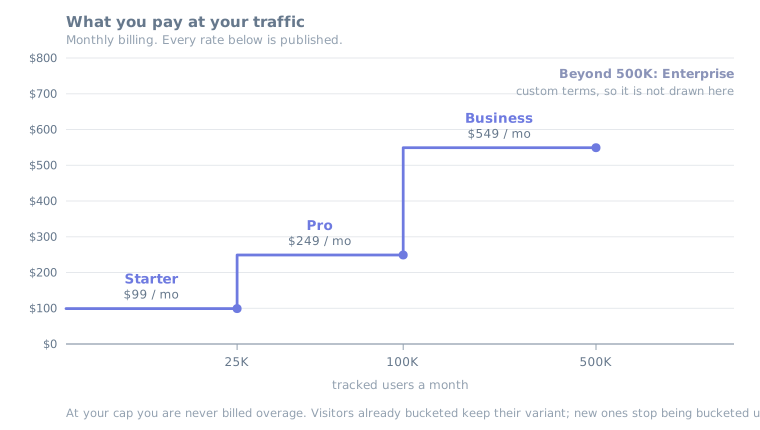
| Published price at 100,000 monthly tracked users | None. The only public figures are third party aggregator estimates: Vendr reports a median annual contract of $81,447 across 126 purchases, the middle 80 percent falling between $26,460 and $261,075, and roughly $50,000 to $80,000 a year at mid market for Intelligence Cloud, the experimentation line. Vendr's estimates, not Optimizely's prices | Not published at this tier. Ask VWO for a quote | Growth: $399 / mo billed monthly, or $3,588 / yr billed annually, which works out at $299 a month. Pro: $599 / mo billed monthly, or $5,040 / yr billed annually. Enterprise on request, annual only | Pro: $249 / mo billed monthly, or $2,388 / yr billed annually, which works out at $199 a month. Starter is $99 / mo for 50,000 and Business is $549 / mo for 500,000 |
| Billing unit | Set by the contract. Nothing is published | Monthly tracked users, counted per product. A visitor who touches two separately purchased VWO products consumes quota in each of them, and quota does not roll over | Monthly Tested Users, written MTUs | Monthly tracked users. A bucketed visitor counts as a tracked user whether or not the variation changed anything on the page |
| Trial terms | The trial page is a lead form and publishes no duration, so treat the widely quoted 30 day figure as unsourced. There is a free tier, but it covers Feature Experimentation, the feature flagging product, capped at one concurrent experiment. It is not Web Experimentation | A 30 day free trial that starts without payment details and carries no feature restrictions, which you can begin yourself and skip the demo. The most generous trial of the four. It is not linked from the pricing page, where every tier routes to a demo booking | 15 day free trial, which starts without payment details | 14 day free trial on monthly plans. A card is required at signup and nothing is charged until day 15, and every plan carries a 30 day money back guarantee on your first paid month |
| Statistics method | Stats Engine: continuous monitoring with false discovery rate control. Optimizely describes it as distinct from both frequentist and Bayesian methods, with a frequentist style interpretation. The mechanics are in the statistics section below | SmartStats is Bayesian and now applies to accounts on the older framework. Newer accounts use Campaign Reports, which offers Bayesian and frequentist models. A built in Bonferroni style correction across variations can be toggled on or off | Frequentist t tests with a configurable confidence level, and Bayesian with credible intervals, both on every plan. Anytime valid sequential testing on Pro and Enterprise, using Asymptotic Confidence Sequences. Bonferroni or Sidak across variants, and their own docs recommend Sidak | Three engines: a frequentist z test at 95 or 99 percent, an anytime valid sequential engine, and a Bayesian engine. Frequentist on every plan, the other two from Pro. Each judges conversion and revenue, with an optional Bonferroni or Sidak correction across variants |
| Authoring model | Visual editor plus code | Visual editor plus code | Visual editor first, with a code editor beside it. Convert's own docs note that Visual Editor changes (DOM mutations defined in the UI) are not delivered to Fullstack-SDK callers, so a variation drawn in the interface is not something a code level consumer can reuse | Code only. Experiment configuration is JSON, and every variation is JavaScript and CSS you wrote in a Monaco editor. There is no visual editor at all |
| Snippet and runtime | A Web Experimentation snippet on the client side, with Feature Experimentation SDKs server side. Optimizely recommends running the two alongside each other rather than choosing between them | SmartCode, one snippet before the closing head tag, in an async and a sync variant. The async variant carries a page load timer and falls back to the original page if the page fails to load in time. The timeout itself is not published, so do not trust a number for it | A tracking script, with a separate Fullstack SDK for code level consumers | About 31 KB gzipped behind a loader under 1.5 KB. Configuration is served from the edge; bucketing and variation application run in the visitor's browser |
| Product scope | Nine products under the Optimizely One banner. Web Experimentation is the client side line and Feature Experimentation, formerly named Full Stack, is the server side one. Packaged per customer, so what you get depends on the contract | One tag serves eight products: Testing, Feature Experimentation, Insights, Personalization, Commerce, Engage, Pulse and Wandz. Removing the tag can therefore affect more than testing | A/B, split URL and multipage testing, with multivariate, full stack and feature flags on Pro. Native heatmaps on every plan, plus session recordings branded Convert Signals | A/B with multiple variants, and split URL. No multivariate, no feature flags, no server side SDK, no personalization. Heatmaps sit in the optional ABTestly Signals add on rather than the core testing product, and there are no session recordings and no surveys |
| What happens when you go over | The price is private but the terms are not. Clause 2.2 of the published subscription agreement charges overage at two times the usage volume unit price, invoiced monthly in arrears, and clause 2.8 forbids reducing your usage volume mid term | No overage charge is documented. When the purchased visitor quota runs out a campaign is effectively paused and stops collecting new data until the quota renews. Quota does not roll over, and it is counted per product, so a visitor touching two VWO products consumes quota in each | Growth bills $399 per extra 100,000 tested users, Pro and Enterprise bill $699 per extra 250,000, and the whole mechanism can be switched off. That is a fairer default than most of this market ships | Nothing is billed automatically. Visitors already bucketed keep their variants, new visitors stop being bucketed, and an email arrives at 80 percent and again at 100 percent |
One name, two products. Convert's session recording and behavioral analysis feature is branded Convert Signals. ABTestly sells a separate optional add on, also called Signals, which reads a page and drafts test hypotheses. Same word, different companies, unrelated products. This page keeps the company name attached to both, because the word on its own would be ambiguous here.
The price at 100,000, with the billing period attached
Two of the four publish a number at this volume and two do not, so this table is short on purpose. The thing that trips people up is the cycle: a bare Convert figure can mean either $399 or $299 depending on which one someone copied, and those are 25 to 30 percent apart. Read both columns before you quote either.
| Plan | Billed monthly | Billed annually | What the number covers |
|---|---|---|---|
| Convert Growth | $399 / mo, $4,788 / yr | $3,588 / yr, which is $299 a month | 100,000 Monthly Tested Users, with 5 active experiences and 30 goals per project |
| Convert Pro | $599 / mo | $5,040 / yr, which is $420 a month | Lifts the per project experience ceiling, which is usually the reason people move up |
| Convert Enterprise | Not offered | Price on request, annual only | Quoted |
| VWO | Not published at this tier | Not published at this tier | VWO does not publish a 100,000 tracked user price on its public page, so ask VWO for a current quote rather than trusting a number from us |
| Optimizely | Not published | Not published | Vendr aggregator estimates only: a median annual contract of $81,447 across 126 purchases, the middle 80 percent falling between $26,460 and $261,075, analysis updated February 2026 |
| ABTestly Pro | $249 / mo, $2,988 / yr | $2,388 / yr, which is $199 a month | 200,000 monthly tracked users, unlimited experiments, 3 seats |
Against the one competitor number that is public at this tier, the annual gap is $1,200 a year and the monthly gap is $1,800 a year. Whether that gap is worth taking depends almost entirely on who writes your variants, which is the subject of the next two sections. The tier by tier detail sits on the Convert alternative page, and the aggregator caveats sit on the Optimizely alternative page.
Convert list prices exclude VAT. ABTestly prices are billed through Paddle as merchant of record, and applicable tax is handled at checkout. Vendr publishes negotiated contract data rather than vendor pricing, its figures cover Optimizely contracts broadly rather than any one product, and only a current quote is authoritative for you.
Statistics, where the real differences are
This is the part of a four way comparison most likely to be written dishonestly, so here it is carefully. Optimizely's Stats Engine supports continuous monitoring and controls the false discovery rate across the metrics and variations in a test. Optimizely describes it as distinct from both frequentist and Bayesian approaches, while carrying a frequentist style interpretation. Mechanically it computes 100 successive confidence intervals as data arrives; the significance it reports is the smallest observed across them, and the interval it reports is the intersection of them. Calling it Bayesian, which happens constantly in comparison articles, is simply wrong.
Two more things belong on the Optimizely side before we leave it. The correction is a tiered false discovery rate control, where the first metric is treated as primary and evaluated on its own, metrics two through five are secondary, and anything past the fifth is weighted for monitoring rather than decisions. And that control is not maintained once you segment a result, which is exactly when people go looking for one. Optimizely now also lists fixed horizon frequentist and Bayesian methods beside Stats Engine, both in beta and reached through an account manager.
Convert publishes more of its method than any of the other three. Frequentist t tests with a configurable confidence level and one or two tails, and Bayesian with credible intervals, are on every plan. Anytime valid sequential testing, using Asymptotic Confidence Sequences, is on Pro and Enterprise. A Bonferroni or Sidak correction is available across variants and their own documentation recommends Sidak over Bonferroni.
VWO depends on which framework your account is on. SmartStats, the Bayesian engine, applies to accounts on the older framework and to campaigns created before migration. Newer accounts use Campaign Reports, which offers Bayesian and frequentist models. A built in Bonferroni style correction runs across variations and can be toggled off, and VWO is explicit that it is not textbook Bonferroni: rather than shifting the decision boundary it folds the uncertainty into the reported values. So "VWO is Bayesian" is right for one kind of account and wrong for the other, which is worth establishing before you compare a verdict to anyone else's.
ABTestly ships three engines: a frequentist z test at 95 or 99 percent, an anytime valid sequential engine, and a Bayesian engine, each judging conversion and revenue, with an optional Bonferroni or Sidak correction across variants. Frequentist is on every plan and the other two are on Pro and up. What we will not tell you is that any of that is equivalent to Stats Engine, or even like it. Anytime valid testing and multiplicity correction across many metrics are separable mechanisms, and two products can implement one without implementing the other the same way. If you move a test between two tools, do not expect the thresholds or the verdicts to agree. Our methods are written out in the docs so you can judge them on their own terms rather than by analogy to someone else's.
One thing worth checking in all four: what happens when the split itself is broken. A test that sent 52 percent of visitors to one variant is not a close result, it is a broken experiment, and a tool that reports the first without flagging the second will cost you a decision. All four do something here, and the differences are in when it fires rather than whether it exists. Optimizely runs automatic detection with a sequential method, scoped to A/B tests on Manual traffic distribution with Stats Accelerator off, running 45 days or less, with at least 1,000 visitors, and not on segmented results. VWO lists Sample Ratio Mismatch Detection among its Experiment Vitals, on Pro and Enterprise but not on Growth, so on VWO the guard depends on your tier. Convert runs a chi square goodness of fit test that triggers at 99 percent confidence, on every plan, switched on per project. ABTestly runs a chi square check on every plan and flags it on the results panel.
Authoring, and what the tag does to the rest of your site
Optimizely, VWO and Convert are all visual editor products with code available beside the editor. That is a genuine strength: a page owner can build and QA a variant without waiting for a developer, and it is the single biggest thing you give up by moving to a code only tool. It also carries the consequence quoted from Convert's docs in the table above, and it is worth knowing before anyone plans code level work. A variation drawn in an interface is editor state rather than portable code, which is why a migration between any two of these tools costs hours rather than minutes.
The tag itself differs more than the editors do. VWO's SmartCode is one snippet placed before the closing head tag, in an async and a sync variant, and the async variant carries a page load timer that falls back to the original page if the page does not load in time. VWO does not publish the timeout, so treat any specific number you read for it as invented. The more important property is that one tag serves eight products, so removing it can affect more than testing. Conversion tracking has seven goal types, of which Track Revenue On needs extra JavaScript and Track Form Submits To covers standard HTML forms only, and legacy Goals are campaign scoped while Metrics under Data360 are reusable but conditional on Data360 being enabled.
ABTestly sits at the narrow end of this range deliberately. One tag, one product, and every variation is JavaScript and CSS somebody wrote and can review. Configuration is served from the edge, and bucketing and variation application run in the visitor's browser. The limit of that model is worth stating too: targeting, goals, allocation and method settings live in the ABTestly dashboard, there is no repository sync today, and we are not going to imply one.
Which of the four is the right pick
All four have a real audience. Here is who each one is for, written so you can rule us out quickly if we are wrong for you.
Choose Optimizely if
- You need server side experimentation and feature flags as a first class product, not a side effect of a testing tool
- Personalization or multivariate testing is part of the program
- Procurement requires an enterprise vendor with MSAs and SLAs
- Stats Engine is specifically what your analysts trust to call a result
- You are ready to commit. Subscriptions renew for twelve months on their own, stopping that takes ninety days written notice before the term ends, and orders are non cancellable, per the published subscription agreement
Choose VWO if
- You want a full CRO suite behind one login and one tag
- Insights, personalization and feature experimentation matter as much as A/B tests
- A page owner needs to build variants without a developer
- You are comfortable asking for a quote before you see a price
Choose Convert if
- You want a published price and a mature visual editor in the same product
- Multivariate or full stack testing is on the roadmap
- Native heatmaps and session recordings are part of how your team finds problems
- Formal compliance certifications are a requirement today
- Your data has to stay in the EU. Convert runs on servers in Frankfurt, uses first party cookies, and offers a signed data processing agreement
- You are an agency running several clients, and want them separated as projects inside one account rather than as separate contracts
Choose ABTestly if
- The people writing your variants already write code, and a WYSIWYG layer is a step they work around
- You want a price you can read at your volume without a call
- You want three statistics engines and a published methodology behind the verdict
- You want the scope of a testing tool and not a suite, at about 31 KB gzipped
Still weighing two of them against each other rather than all four? The single vendor pages go deeper than this one can: Optimizely alternative, VWO alternative, Convert alternative and AB Tasty alternative, which matters more than it used to now that AB Tasty and VWO are the same company. If you would rather judge a workflow than a table, rebuild one experiment and see how it feels.
Quick answers
Are VWO and AB Tasty the same company now?
Yes. The two merged, and on 13 June 2026 at 11:00 PM PDT both platforms came together under a single brand, Wingify. app.vwo.com now redirects to app.wingify.com, and vwo.com continues to operate. Checked on vwo.com on 6 September 2026. It changes your shortlist rather than your setup: if both products were on your list, you are choosing between two lines under one roof rather than two vendors bidding against each other, so read the AB Tasty alternative page alongside the VWO one.
Did the Wingify cutover break anything on my site?
No, and we are not going to claim it did. The vendor post says SmartCode does not need replacing, campaigns and flags keep running, history is preserved, and logins, contracts, pricing terms, REST endpoints and CSP are all unchanged. Checked on vwo.com on 6 September 2026. A rebrand is a poor reason to change tools. A workflow that suits your team is a good one.
What does each one cost at 100,000 monthly tracked users?
Convert Growth is $399 a month billed monthly, or $3,588 for the year billed annually, on its Monthly Tested Users unit. At 100,000 monthly tracked users, ABTestly Pro is $249 a month billed monthly, or $2,388 for the year billed annually, and it includes up to 200,000. Optimizely publishes no prices at all: the only public figures are third party aggregator estimates, and Vendr reports a median annual contract of $81,447 across 126 purchases with the middle 80 percent falling between $26,460 and $261,075. VWO does not publish a 100,000 tracked user price on its public page, so ask VWO for a current quote rather than trusting a number from us. Vendor figures checked 6 September 2026, and the two Convert cycles differ by roughly 25 to 30 percent, so always read the billing period beside the price.
Is Optimizely's Stats Engine Bayesian?
No. Optimizely describes Stats Engine as distinct from both frequentist and Bayesian methods, while carrying a frequentist style interpretation. It supports continuous monitoring and controls the false discovery rate, computing 100 successive confidence intervals, reporting the smallest significance observed across them and the intersection of the intervals. Checked on support.optimizely.com on 6 September 2026. ABTestly ships a separate anytime valid sequential engine and a separate Bayesian engine, and we do not claim either is equivalent to Stats Engine. Anytime valid testing and multiplicity correction across many metrics are separable mechanisms. If you move a test between two tools, do not expect the thresholds or the verdicts to agree.
Which of the four can I try without talking to a salesperson?
Convert publishes a 15 day free trial that starts without payment details. ABTestly publishes a 14 day free trial on monthly plans; a card is required at signup, nothing is charged until day 15, and every plan carries a 30 day money back guarantee on your first paid month. Optimizely's trial page is a lead form with no published duration, so treat the widely quoted 30 day figure as unsourced, and its free tier covers Feature Experimentation, the feature flagging product, capped at one concurrent experiment, rather than Web Experimentation. VWO offers a 30 day free trial that starts without payment details and carries no feature restrictions, and you can begin it without talking to sales, though it sits on its own page rather than the pricing page. Checked 6 September 2026.
Is Convert a testing only tool with no heatmaps?
No, and that claim is out of date wherever it still appears. Convert's features page lists native heatmaps included on all plans, plus session recordings branded Convert Signals. Checked on convert.com on 6 September 2026. One caution about the name: ABTestly sells a separate optional add on also called Signals, which reads a page and drafts test hypotheses. Different companies, unrelated products, so this page always writes the company name in front.
Why is ABTestly on a page about the other three?
Because we make it, and it is the fourth column rather than the subject. Every competitor line here carries a source and the date we checked it, and where we could not verify something we say so instead of estimating. ABTestly is a narrow product: client side A/B and split URL testing authored in code, with no visual editor, no multivariate testing, no feature flags and no server side SDK. If your program needs any of those, one of the other three fits better, and we would rather you worked that out here than after a migration.
Sources checked
All checked on 6 September 2026 unless stated otherwise. Prices, plan limits and product scope change, so verify before you rely on a number.
- VWO and AB Tasty merger, the Wingify brand and the cutover detail: vwo.com, aligning our domain
- VWO SmartStats, the Bayesian engine on the older framework: help.wingify.com, what is SmartStats
- VWO statistical models on newer accounts: help.wingify.com, Campaign Reports models
- VWO Bonferroni correction: help.wingify.com, Bonferroni correction
- VWO quota exhaustion behaviour: help.wingify.com, campaign report warnings
- VWO quota counted per product: help.wingify.com, Web Rollout quota FAQs
- VWO Sample Ratio Mismatch Detection, listed on Pro and Enterprise: help.wingify.com, Experiment Vitals
- VWO pricing, every tier routing to a demo: vwo.com/pricing
- Convert pricing, plan ceilings, trial and overage: convert.com/pricing
- Convert heatmaps, session recordings and test types: convert.com/features
- Convert tracking script and SDK: docs.developers.convert.com, tracking script to SDK
- Convert statistical methods: support.convert.com, statistical methods used
- Convert SRM check: support.convert.com, what is SRM
- Convert quota and over quota charges: support.convert.com, prevent extra charges
- Optimizely packaging and the absence of published prices: optimizely.com/plans, which optimizely.com/pricing now redirects to
- Optimizely trial request form: optimizely.com/trial
- Feature Experimentation, formerly Full Stack: docs.developers.optimizely.com, feature experimentation
- Optimizely Rollouts, the free tier and its one experiment limit: support.optimizely.com, Feature Experimentation FAQs
- Optimizely subscription agreement, published 10 November 2025: optimizely.com/legal/terms
- Optimizely false discovery rate control: support.optimizely.com, false discovery rate control
- Optimizely automatic SRM detection: support.optimizely.com, automatic SRM detection
- Stats Engine methodology: support.optimizely.com, statistical analysis methods overview
- Optimizely contract benchmarks, analysis updated February 2026: vendr.com marketplace listing
- ABTestly pricing and plan limits: abtestly.com/pricing
- ABTestly statistics methods: docs.abtestly.com/results/engines
- ABTestly exact experiment ledger: docs.abtestly.com/results/exact-ledger
Optimizely, VWO, Wingify, AB Tasty and Convert are trademarks of their respective owners. ABTestly is not affiliated with, endorsed by, or sponsored by any of them.