PostHog vs ABTestly. Analytics platform or focused experimentation?
PostHog product and pricing details checked against posthog.com on 6 September 2026. Check their site for current numbers.
Yes, we are ABTestly, so read this knowing who wrote it. Every PostHog claim below is checked against posthog.com, and there is a real section on where PostHog is the stronger choice. For a lot of teams, it is.
The 30 second answer
Pick PostHog if you want experimentation to live inside the same platform as your product analytics, session replay, feature flags and warehouse data. Its experiments can use the events, funnels, flags and warehouse tables you already have.
Pick ABTestly if A/B testing is the job. It is built around client side experimentation: write the variant in JavaScript and CSS, preview it on the live page, target the right visitors, watch the sample ratio check and guardrails, and decide from an experimentation specific results workflow.
Neither is universally better. It comes down to whether you want a product platform that happens to include experiments, or an experimentation tool that stays focused on them.
Head to head
| PostHog | ABTestly | |
|---|---|---|
| Core positioning | Broad product and data platform with experimentation as one product among many | Focused platform for teams that build, QA and ship client side web experiments |
| Experiment implementation | Backed by a feature flag. Application code checks the assigned variant | Browser variation authored directly as JavaScript and CSS in a Monaco editor |
| Visual editor | Yes, a no code web experiment editor in the toolbar: text, CSS and HTML overrides per variant. It is beta and off by default, needing both a feature preview and disable_web_experiments: false in the snippet. Their docs mark single page apps and complex interactions as unsupported, and there is no anti flicker path: PostHog's own post says zero flicker is not possible for no code experiments | No visual editor. Every variation is JavaScript and CSS |
| Multiple variants | Yes, one control plus up to nine test variants | Yes, multiple variants per experiment |
| Split URL tests | Achievable as a documented redirect and flag code pattern, not a native configuration option. An open PostHog GitHub issue asks for native support | Yes, a native test type |
| Feature flags | Yes, the default assignment mechanism for experiments | Not offered. ABTestly is built around browser variations, not flags |
| Product analytics | Yes, a full product analytics suite | No product analytics suite. Results, heatmaps and business impact live inside the experimentation workflow |
| Session replay | Yes, every variant links to the session replays of the people who saw it | No session replay. Experiment heatmaps show aggregate click, scroll and attention patterns, not individual recordings |
| Data warehouse metrics | Yes, warehouse tables can back mean, ratio, retention and funnel metrics | No native data warehouse |
| Existing event and funnel metrics | Yes, any event or funnel already built in PostHog can become an experiment metric | Goals are defined inside the ABTestly experimentation workflow |
| Statistics engines | Bayesian by default, frequentist optional, with CUPED variance reduction and winsorization. Sequential testing is frequentist only and opt in, so the default engine does not have it. Neither engine corrects for multiple comparisons, and PostHog says so plainly: with ten metrics the chance of at least one false positive is about 40 percent | Frequentist on every plan. Sequential and Bayesian on Pro, applied to conversion and revenue |
| CUPED variance reduction | Yes | Not offered |
| Holdouts | Yes, a dedicated feature for measuring long term effects over months, shown as a variant in analysis with its own credible interval and chance to win | Mutual Exclusion Groups can reserve a holdout cell that stays out of every experiment in the group (Business and up), but a generation change reshuffles it, so it is a control within one generation, not a persistent program level holdout. Different model |
| Sample ratio integrity | An automatic chi squared check once an experiment has 100 exposures, flagged below the exposures table at p below 0.001. Their Self-driving auditor separately watches for contamination, stalls and mid run flag edits | Yes (chi square check flagged on the results panel) |
| Coordinating experiments | PostHog's own comparison grid marks mutually exclusive experiments and multi armed bandits as things it does not offer | Mutual Exclusion Groups keep experiments in a group off the same visitor (Business and up). No multi armed bandit here either |
| Guardrail metrics | Yes, optional secondary and guardrail metrics you monitor for negative impact | Two system guardrails on every plan. Custom guardrail metrics from Starter |
| Revenue and ecommerce metrics | Measured through events or warehouse metrics, with optional winsorization (percentile capping) for skewed metrics like revenue | Revenue per visitor with outlier control (Starter and up), across all three statistics engines. Docs |
| Variant performance guardrail | Not found in current documentation | Per variant p75 LCP guardrail (Pro and up) |
| Experiment heatmaps | General website heatmaps exist (clickmaps and scrollmaps from autocapture), always on and not tied to any specific experiment or variant. Not an experiment-specific, variant-vs-control heatmap | Included on Pro and Business at no extra cost. The Signals add on brings them to Starter |
| AI and automation | Self-driving audits running experiments for validity threats. PostHog MCP manages flags and experiments from an AI editor | Signals scans a page and drafts hypotheses from the evidence it finds. The decision to launch stays explicit |
| API or MCP experiment management | Yes | No public API today |
| Agency and multi-site ergonomics | Organised around projects, where a project is a silo of data with every query scoped to it. The free plan carries one project and pay as you go carries six. Free allowances are stated per account rather than per project, so several client sites in one account draw on the same monthly usage | Sites are explicit in the account model: 2 on Starter, 5 on Pro, unlimited on Business and Enterprise subject to a 100 site fair use ceiling, all sharing one tracked user allowance |
| Hosting and licence | Open source, and you can run it yourself from a free Docker Compose deployment under an MIT licence, with the enterprise directory licensed separately. PostHog calls self hosted deployments officially unsupported, publishes no CVEs or tagged releases for them, offers no commercial support on that path, and keeps every paid plan feature Cloud only. The paid Kubernetes route was retired in 2023 | Closed source and hosted by us. There is no self hosted option and no plan to offer one |
| Paid pricing model | Usage based, with per product billing limits you set yourself | Flat monthly tracked user tiers: Starter $99, Pro $249, Business $549, with annual discounts and custom Enterprise pricing |
| Charged by surprise | No. Free usage stops at the free tier limits, and paid billing limits are yours to set | No. No automatic overage charges on any plan |
| Best fit | Product and growth teams who want analytics, flags, replay and experimentation in one platform | CRO developers and technical teams whose main job is building and shipping web experiments |
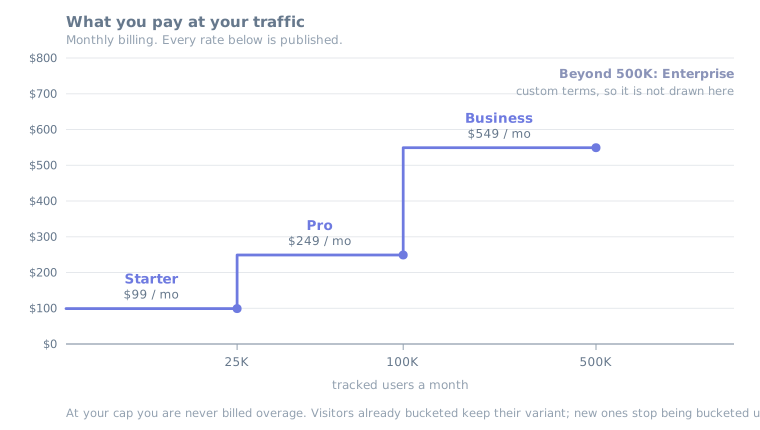
PostHog figures are usage based and billed together with feature flag requests. ABTestly figures are flat monthly tracked user tiers. The two do not convert cleanly into one number. See Pricing below.
The biggest difference has nothing to do with features. It is what each product is for.
PostHog is intentionally broad. Its pricing page lists product analytics, session replay, feature flags, experiments, error tracking, surveys, a data warehouse, data pipelines and AI features as one connected product. That is a real advantage if your experimentation program should share a platform with the rest of your product data, since data you already collect in PostHog can become an experiment metric without a separate measurement layer.
ABTestly does deliberately less outside experimentation: page and audience targeting, JavaScript and CSS variations, preview and QA, goals, statistics, a sample ratio check, guardrails, revenue metrics, experiment heatmaps, a speed guardrail, business impact, and Signals for hypothesis generation. It is built for the person whose day is closer to build this variation, QA it, target it, measure it, decide whether to ship it, than run a product analytics stack.
Narrower is not automatically better. It is better only when experimentation is the workflow you actually want the product to optimize.
How the experiment gets built
PostHog
- Create the experiment and name a hypothesis
- PostHog creates a feature flag for it, or you link an existing one
- Configure variants and their traffic split
- Set inclusion criteria and pick metrics
- In your application code, check the feature flag's assigned variant and render the matching behavior
- PostHog's SDK sends a feature flag exposure event automatically when the flag is checked. A custom exposure event is also configurable
ABTestly
- Define the experiment and its targeting
- Author the browser variation in JavaScript and CSS in Monaco
- Preview the variant on the live page
- Variation code checks run on save, publish and resume
- Launch
- The runtime applies the variant to eligible visitors in the browser
- Goals and results flow into the experiment's own results page
PostHog: the application owns the variant behavior. PostHog owns assignment, exposure and analysis.
ABTestly: ABTestly owns the experiment configuration and applies the JavaScript and CSS variation on the target page.
One wording note, since we get asked: experiment configuration is served from Cloudflare's edge. Bucketing and applying the variation both run in the visitor's browser, not at the edge.
Feature flags or browser variations?
PostHog
Feature flags are the core primitive. An experiment is normally backed by a flag, a visitor or group is assigned a variant, and your application checks the flag and changes behavior. Release conditions can use cohorts, groups or properties, and an experiment can reuse a flag you already have. PostHog also documents ways to run experiments without its own flags.
ABTestly
There is no feature flag experimentation today. Every variation is browser side: JavaScript and CSS authored against page, URL and audience conditions, applied by the runtime in the visitor's browser.
If flags are already how your engineering team ships changes, PostHog is the more natural fit. If the work is mostly client side CRO, landing pages, product pages, navigation, merchandising, forms and messaging, ABTestly's variation model is closer to the work itself.
Both take statistics seriously. The workflow is different.
PostHog
- Bayesian statistics
- Frequentist statistics
- CUPED variance reduction
- Running time and sample size guidance
- Primary and secondary metrics, plus custom exposure criteria
- Warehouse backed metrics
- Self-driving validity audits for skewed splits, contamination, stalls and mid-run flag edits
ABTestly
- Frequentist on every plan. Sequential and Bayesian on Pro
- A chi square sample ratio check on the results panel
- Custom guardrail metrics from Starter
- Revenue per visitor with outlier control (Starter and up)
- An exact event ledger on every plan, with time to decision (Pro)
- A plain English verdict
- The per variant LCP guardrail (Pro)
- A business impact summary (Business)
PostHog has real experimentation methodology and should get credit for it. ABTestly's difference is that sample ratio, guardrails, revenue, speed and the final decision sit at the center of a product built specifically around running the experiment, not as one section of a broader analytics tool.
Neither tool fixes a weak hypothesis
Changing a headline or a button color rarely moves a real metric on its own, and the data on this is not close. Ronny Kohavi's experimentation team at Microsoft found that of ideas actually tested, roughly a third were positive and statistically significant, roughly a third were flat with no significant difference, and roughly a third made things worse. That was inside one of the most disciplined, best resourced experimentation programs in the industry.
The published case studies do not raise the odds much either. When statistician Georgi Georgiev re-ran the numbers on a widely referenced archive of 115 published A/B tests, about 70 percent turned out to be statistically underpowered, mostly consistent with stopping a test early once it looked good. Once the weak ones were set aside, only 31 of the 115, 27 percent, held up as a genuine statistically significant win.
Neither PostHog nor ABTestly changes those odds by itself. A statistically sound platform tells you honestly whether an idea worked. It does not make the idea good. That is part of why Signals starts from actual page evidence, heatmaps, GA4 data, observed friction, rather than a guess about what color a button should be. PostHog's Self-driving plays a related but different role: it audits whether a running experiment's measurement is trustworthy, not whether the idea behind it was worth testing. If a testing program mostly changes copy and colors, the bigger lever is usually the hypothesis, not the platform.
Where PostHog has the obvious advantage
If you want product analytics and experimentation in the same system, PostHog is the stronger product, plainly. An experiment can use events you already capture, funnels you already built and data from warehouse tables. Each variant can also link to session replays of the people who saw it. ABTestly does not try to replace a product analytics platform, a data warehouse or a general session replay product.
For a product team already deeply instrumented in PostHog, that integration can matter more than anything a separate experimentation platform offers.
The second advantage is one we cannot answer at all. PostHog is open source, and you can host it yourself from a free Docker Compose deployment under an MIT licence. If your data cannot leave your own infrastructure, or you want the option of reading the code that decides your experiment assignment, that settles the question before any feature table matters. ABTestly is closed source and hosted by us, and we have no self hosted option. Two honest caveats on their side, both from their own docs: self hosted deployments are officially unsupported with no commercial support behind them, and every paid plan feature is Cloud only, so self hosting means the free tier feature set.
Where ABTestly is more focused
ABTestly starts from a different assumption: the person building the experiment already writes JavaScript and CSS.
Instead of a feature flag as the central primitive, ABTestly gives each browser variation explicit JavaScript and CSS in a Monaco editor, live page preview, static code checks, URL and audience targeting, activation triggers, and a results workflow built around one experiment at a time.
- Explicit JavaScript and CSS variations
- Live preview before launch
- Variation code checks on save and publish
- URL, audience and segment targeting
- Click, element view and manual activation triggers (Pro)
- A GA4 friendly exposure event
- Experiment heatmaps (Pro and up)
- The LCP speed guardrail (Pro)
- A multi site account model for agencies
The pricing models are not directly comparable
PostHog and ABTestly do not price the same thing, so a clean one number comparison would be misleading.
PostHog bills by product usage. Experiments are not a separate line at all: they are billed with feature flag requests, on a meter their billing API literally calls Feature flags and Experiments. The free tier currently includes 1 million feature flag requests a month alongside 1 million analytics events, 5,000 session replays and unlimited team members. Past the first million, flag requests start at $0.0001 each and the unit price falls as volume rises. Flat rate platform packages sit alongside that for SSO, audit logs and role based access, starting at $250 a month. ABTestly prices by monthly tracked users, meaning unique visitors actually bucketed into a running experiment.
If you already run PostHog for analytics and flags, experimentation may fit inside usage you are generating anyway. If you want a standalone testing budget that scales with tested visitors, ABTestly's tracked user model is easier to forecast from an experimentation program alone.
Pricing checked 6 September 2026.
For agencies and teams testing several sites
ABTestly's account model makes multiple sites explicit: 2 on Starter, 5 on Pro, and unlimited on Business and Enterprise subject to a 100 site fair use ceiling that ABTestly will raise on request. Every site in an account shares one tracked user allowance and one bill, and on every plan with more than one seat, an admin can scope each member to chosen sites.
PostHog organises the same work into projects, and a project is a silo of data with every query scoped to it. The free plan carries one project and pay as you go carries six, so an agency separating clients properly needs the paid plan for that reason alone. Free allowances are stated per account rather than per project, which means several client sites share one monthly pool the way sites share a tracked user allowance here.
Where each one wins
Where PostHog genuinely wins
- Product analytics. A full, native capability. ABTestly is not a product analytics suite.
- Session replay. Every experiment variant links to replays of the people who saw it. ABTestly has no general session replay product.
- General website heatmaps. Always-on clickmaps and scrollmaps, not tied to a specific experiment. ABTestly's heatmaps are experiment-specific (variant vs. control) rather than general purpose.
- Feature flags. The default way PostHog experiments get built. ABTestly has no feature flag experimentation today.
- Warehouse connected experiments. Warehouse tables can back mean, ratio, retention and funnel metrics. ABTestly has no native data warehouse.
- Existing instrumentation. Events and funnels already built in PostHog can become experiment metrics with no extra setup, and PostHog supports optional winsorization for skewed metrics like revenue.
- CUPED. A documented variance reduction method. ABTestly does not offer it.
- Group targeted experiments. PostHog can run an experiment at the group level, not just the visitor level.
- Developer platform breadth. Web, API, MCP, feature flags and the wider analytics stack in one account.
- A generous free allowance. 1 million feature flag requests and 1 million analytics events a month, at last check.
Where ABTestly is the better fit
- A dedicated web experimentation workflow. Experimentation is the product, not one section of a larger platform.
- Direct JavaScript and CSS variation authoring in Monaco, not a flag plus application code round trip.
- Live page preview and variation code checks built around implementation and QA.
- A sample ratio check as a first class result, not something you have to go looking for.
- Guardrails by default. Two system guardrails on every plan, custom guardrail metrics from Starter.
- Three statistics engines: frequentist, sequential and Bayesian.
- An experiment specific revenue workflow: revenue per visitor with outlier control (Starter and up). Methodology documented.
- A per variant web performance guardrail: LCP (Pro and up).
- Experiment heatmaps, variant against control, included from Pro.
- Signals, which scans a page and drafts hypotheses tied directly to creating an experiment.
- A site oriented account model built for agencies running several brands from one login.
- Flat, predictable pricing with no automatic overage charges.
Which should you choose?
Choose PostHog if
- You want one platform for analytics, feature flags, session replay, warehouse data and experiments
- You already run PostHog and want experiments to reuse that instrumentation
- Feature flags are how your engineering team already ships changes
- You need CUPED, group targeted experiments, or warehouse metrics tied into experiment analysis
- A generous usage based free tier suits your stack
Choose ABTestly if
- You are mainly buying an A/B testing platform, not a product data platform
- Your experiments are mostly browser side CRO changes
- Your team writes JavaScript and CSS rather than working through a flag and application code
- Preview, QA, sample ratio checks, guardrails, revenue metrics, heatmaps and a speed guardrail should live around one experiment workflow
- You run several client or brand sites and want an experimentation specific account model
- You would rather pay for tracked users in an experimentation program than for usage across a wider platform
Unsure? Do not migrate a whole program to find out. Take one representative experiment, recreate it in ABTestly, and compare the workflow before you decide anything else. See our pricing.
Which model sounds more like your team?
Staying inside PostHog is probably the lower friction choice. Come back to ABTestly if the experimentation workflow itself, or managing several client sites, becomes the actual pain point.
That is closer to what ABTestly is built for. Start with one representative experiment before you touch anything else in your stack.
Quick answers
Is PostHog an A/B testing tool?
Yes. PostHog has a dedicated Experiments product. Experiments are normally backed by a feature flag, and can use existing PostHog events, funnels and warehouse data as metrics, with Bayesian or frequentist statistics. It sits inside a wider platform that also includes analytics, session replay, feature flags, a data warehouse and more.
What is the main difference between PostHog and ABTestly?
PostHog is a broad product data platform that includes experimentation. ABTestly is built specifically for web experimentation: browser variations written in JavaScript and CSS, with targeting, QA, statistics, guardrails and a results workflow built around that one job.
Does PostHog use feature flags for experiments?
Usually, yes. PostHog's guided experiment flow creates or links a feature flag that assigns the variant. PostHog also documents ways to run experiments without its own feature flags.
Does ABTestly have feature flags?
No. ABTestly is built around client side A/B and split URL testing, not feature flag experimentation.
Does ABTestly have a visual editor?
No. Every browser variation is JavaScript and CSS, written in a Monaco editor. PostHog does have a no code visual editor for web experiments in beta, though its own documentation recommends against relying on it as your primary approach for a shipped experiment.
Which is cheaper, PostHog or ABTestly?
There is no honest single number answer, because the two bill in different units. PostHog experiments are billed through feature flag usage, with a large monthly free allowance. ABTestly prices by monthly tracked users actually bucketed into a running experiment. Compare against your own traffic and product usage rather than converting one model into the other.
Is PostHog better for product teams?
It can be, especially for a team that wants analytics, session replay, feature flags, warehouse data and experimentation in one platform. ABTestly is the more focused choice when the main workflow is client side experimentation.
Is ABTestly better for CRO agencies?
ABTestly's browser variation model and multi site account, 2 sites on Starter, 5 on Pro, unlimited on Business and Enterprise, can fit a CRO agency running several client or brand sites from one login. Whether it beats PostHog depends on whether the agency also needs PostHog's broader analytics and feature flag stack.
Can I test ABTestly before moving off PostHog?
Yes. Start with a 14 day free trial on monthly plans. A card is required at signup, and nothing is charged until day 15. Run one representative, low risk test to compare the workflow before making a wider decision.
Do both support frequentist and Bayesian statistics?
Yes. PostHog documents Bayesian and frequentist experiment methods, plus CUPED variance reduction. ABTestly provides frequentist statistics on every plan, with sequential and Bayesian engines on Pro and up.
Sources checked
Checked on 6 September 2026. Prices and product behaviour change, so verify before you rely on a number.
- PostHog experiments overview: posthog.com/docs/experiments
- PostHog creating an experiment: posthog.com/docs/experiments/creating-an-experiment
- PostHog pricing: posthog.com/pricing
- PostHog feature flags: posthog.com/docs/feature-flags
- PostHog Bayesian statistics: posthog.com/docs/experiments/statistics-bayesian
- PostHog frequentist statistics: posthog.com/docs/experiments/statistics-frequentist
- PostHog CUPED: posthog.com/docs/experiments/cuped
- PostHog holdouts: posthog.com/docs/experiments/holdouts
- PostHog exposures: posthog.com/docs/experiments/exposures
- PostHog traffic allocation: posthog.com/docs/experiments/traffic-allocation
- PostHog data warehouse metrics: posthog.com/docs/experiments/data-warehouse
- PostHog no code web experiments: posthog.com/docs/experiments/no-code-web-experiments
- PostHog MCP for experiments: posthog.com/docs/experiments/surfaces/mcp
- ABTestly pricing: abtestly.com/pricing
- ABTestly statistics methods: docs.abtestly.com/results/engines
- ABTestly speed guardrail: docs.abtestly.com/results/speed-guardrail
- ABTestly business impact: docs.abtestly.com/results/business-impact
- ABTestly exclusion groups: docs.abtestly.com/exclusion-groups/overview
- Ronny Kohavi, Microsoft experimentation results: exp-platform.com
- Georgi Georgiev, analysis of 115 published A/B tests: blog.analytics-toolkit.com
ABTestly is an independent A/B testing platform for CRO developers and technical teams. PostHog is a product analytics and developer platform that includes experimentation. ABTestly is not affiliated with, endorsed by, or sponsored by PostHog.
PostHog is a trademark of its respective owner. ABTestly is not affiliated with or endorsed by PostHog.