Looking for an Optimizely alternative?
Optimizely publishes no prices. Every dollar figure on this page is a third party aggregator estimate and is labelled as one. Optimizely's own pages, its published subscription agreement, developer and support documentation, and the Vendr marketplace listing, all checked 6 September 2026.
Optimizely is a serious enterprise platform, and teams rarely leave it because something broke. They leave because they cannot find out what it costs without a sales cycle, because they are paying for a platform when they run client side web tests, or because they want to start this afternoon. If that is the position you are in, here is the honest version of what you would be trading.
Skip ahead to the feature by feature comparison.
What changed at Optimizely in 2026
If you last evaluated Optimizely a year ago, the packaging you remember is gone, and most comparison articles still describe the old one.
The brand relaunched on 22 June 2026. Optimizely repositioned itself as an AI platform for marketing. In the same week the plans page was rebuilt around three packages, Agentic CMS, Agentic Experimentation and Agent Platform, with seven further tools listed beside them. A snapshot from 19 June still showed Web Experimentation and Feature Experimentation as the headline names; one from 25 June showed the new ones.
This is where the comparison articles go wrong. Optimizely has not discontinued anything. Web Experimentation and Feature Experimentation both still ship under their own names, and the Web Experimentation release notes run through 25 August 2026 without a word about deprecation or end of life. Optimizely tells customers their workflows and settings are untouched. So a rebrand on its own is a thin reason to switch tools. It is a decent reason to re read what you are being sold, though, because the package names on the plans page no longer line up with the product names in your contract.
One genuine deprecation, unrelated to the rebrand: the Experimentation desktop app is slated for retirement in the second half of 2026, with the new browser based visual editor replacing it.
What Optimizely costs, as far as anyone outside can tell
There is no list price, and that is deliberate. Optimizely's pricing page states that every plan is individually packaged, and routes you to a demo request. There is no self serve purchase path for Web Experimentation. The trial page is a lead form rather than a signup: you submit details and a representative contacts you about provisioning. It publishes no trial length either, so if you have seen a confident "30 day free trial" quoted in a comparison article, it is not coming from Optimizely's own page. Checked 6 September 2026.
The only public numbers come from aggregators. Vendr, which publishes negotiated contract data rather than vendor pricing, lists a median annual Optimizely contract of $81,447 across 126 purchases, with the middle 80 percent of those contracts falling between $26,460 and $261,075 and the full span running from $6,000 to $1,000,000. Those 126 purchases come from 65 unique buyers, so the spread is wider and the base narrower than a single median suggests. For Intelligence Cloud, the line that covers experimentation and personalization, it reports roughly $50,000 to $80,000 a year at mid market and $200,000 or more at enterprise scale. Vendr's analysis was updated in February 2026; we checked the listing on 6 September 2026. These are Vendr's estimates and not Optimizely's figures, they cover contracts rather than any one product, and only a current quote is authoritative for you.
There is a free tier, and it is not the one people mean. Optimizely publishes a free tier for Feature Experimentation, its feature flagging product, which does not require payment details and is limited to one concurrent experiment. Web Experimentation, the product that compares to a client side A/B testing tool, lists no free plan and no self serve trial. So the flat claim that Optimizely has nothing free is wrong, and the claim that you can evaluate Web Experimentation for free is also wrong. Both halves matter if you are trying to plan an evaluation.
What we are not going to tell you. Optimizely lists three packages and seven further tools on its plans page, and it would be easy to write that you have to buy the bundle to get experimentation. We cannot support that. Vendr's data shows single lines priced separately, and Optimizely packages per customer. The defensible complaint is narrower and still real: because nothing is published, you cannot compare before you talk to someone, and you cannot tell from outside which parts of the bundle you are paying for.
What the contract says, which is the part they do publish
You cannot see Optimizely's prices. You can read its contract. The Online Software Subscription Agreement, published 10 November 2025, sets out what you would be agreeing to whatever number you eventually get quoted. It is worth twenty minutes before the first call.
- Subscriptions renew on their own, in twelve month blocks (clause 1.3).
- Stopping that renewal takes ninety days written notice before the term ends (3.1). Miss the window and you have bought another year.
- Orders are non cancellable and fees non refundable, in those words (2.1).
- Usage volume can go up during a term but never down (2.8).
- Overage costs twice the normal unit price, billed monthly in arrears (2.2).
- Optimizely can raise your price at renewal on a hundred and twenty days notice (1.4).
Two things cut the other way. Nothing in the agreement sets a minimum contract length, whatever you may have read elsewhere. Clause 1.2 leaves the initial term to whatever the individual order says, so a twelve month minimum is not a claim this document supports. A large enough customer can also negotiate most of the rest away, which is rather the point of a sales led model. Everything above is the published default rather than a prediction about your deal.
None of that makes ABTestly the better deal on its own. The difference is that we have nothing for you to negotiate. Our price sits on the pricing page, and we never bill you for going over your limit. Unless you pick annual billing, you are committed for one month at a time.
What ABTestly publishes instead
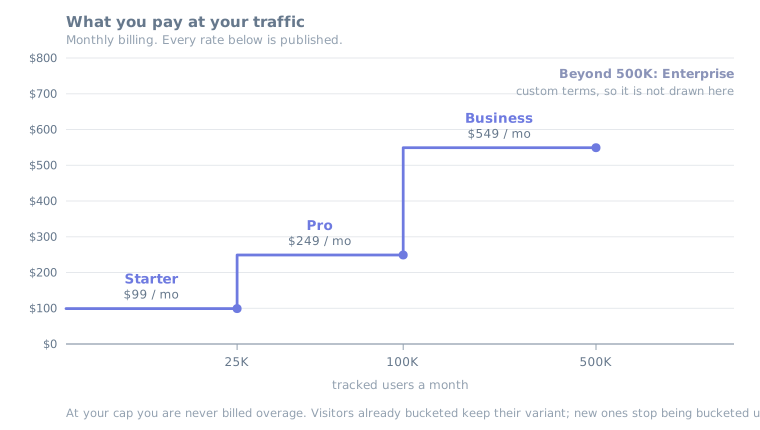
Four tiers, one page, no call. Starter is $99 a month for 50,000 tracked users, 5 experiments and 2 seats. Pro is $249 a month for 200,000 tracked users, unlimited experiments and 3 seats. Business is $549 a month for 500,000 tracked users and 10 seats. Enterprise is custom. Annual billing takes 20 percent off, so Pro is $199 a month billed annually, $2,388 for the year. Exceed your limit and no invoice follows: visitors already bucketed keep their variants, new visitors stop being bucketed, and you get an email at 80 percent and again at 100 percent. Every plan carries a 30 day money back guarantee on your first paid month, and the 14 day free trial runs on monthly plans, with a card required at signup and nothing charged until day 15.
That price buys a deliberately narrow product. ABTestly is client side A/B and split URL testing, authored in code. It has no server side SDK, no feature flags, no personalization, no multivariate testing and no visual editor. If your program needs any of those, the price comparison is the wrong comparison to be running.
Optimizely vs ABTestly, feature by feature
This comparison used to be a separate page. It is here now, so the pricing position and the product differences read as one argument.
How each one is installed and driven
Optimizely Web Experimentation is a snippet loaded from cdn.optimizely.com with your project id in the path, placed at the top of the head. The objects you work in are a project, its experiments and variations, pages for URL targeting, audiences, and events that get converted into metrics. Runtime control is the window["optimizely"] global: a push() command queue for instructions, and get('data'), get('state') and get('visitor') for reading what the snippet decided.
ABTestly is a loader of a few lines that pulls a runtime of about 31 KB gzipped. Experiment configuration is served from Cloudflare's edge in 300 cities with no origin round trip, then bucketing and variation application run in the visitor's browser. The objects are a site with its declared hosts, experiments as JSON, variations as JavaScript and CSS in the Monaco editor, goals from a site scoped library, and audience and URL rules for targeting. There is a browser API for reading and driving assignment from your own code. The shapes are close enough that porting is mechanical work rather than a redesign, which is the main reason a move is measured in days rather than quarters.
Statistics, stated carefully
This is the part of a comparison page most likely to be written dishonestly, so here it is at length. Optimizely's Stats Engine supports continuous monitoring and controls the false discovery rate across the metrics and variations in a test. Optimizely describes it as distinct from both frequentist and Bayesian approaches, while carrying a frequentist style interpretation. Mechanically, it computes 100 successive confidence intervals as data arrives; the significance it reports is the smallest observed across them, and the interval it reports is the intersection of them. Calling it Bayesian, which happens constantly in comparison articles, is simply wrong. Two details worth having before you compare: the correction is tiered, where your first metric is treated as primary and evaluated on its own, metrics two through five are secondary, and anything beyond the fifth is weighted for monitoring rather than decisions; and that false discovery rate control is not maintained once you segment a result, which is exactly when people go looking for one. Optimizely also now lists fixed horizon frequentist and Bayesian methods alongside Stats Engine, both in beta and reached through an account manager, so the older line that Optimizely does sequential and nothing else is out of date.
ABTestly ships three engines: a frequentist z test at 95 or 99 percent, an anytime valid sequential engine, and a Bayesian engine, each judging conversion and revenue, with an optional Bonferroni or Sidak correction across variants. Frequentist is on every plan and the other two are on Pro and up. What we will not tell you is that any of that is equivalent to Stats Engine, or even like it. Anytime valid testing and multiplicity correction across many metrics are separable mechanisms, and two products can implement either one without implementing the other the same way. If you move a test between the two tools, do not expect the thresholds or the verdicts to agree. Our methods are written out in the docs so you can judge them on their own terms rather than by analogy to someone else's.
| Optimizely | ABTestly | |
|---|---|---|
| Pricing model | Quote only. Every plan is individually packaged, per their plans page. No self serve purchase path | Four published tiers on one page, monthly or annual, with checkout online |
| What it costs | Not published. Vendr aggregator estimates: a median annual contract of $81,447 across 126 purchases, and roughly $50,000 to $80,000 a year at mid market for Intelligence Cloud, the experimentation line | Pro: $249 / mo billed monthly, or $2,388 / yr billed annually, for 200,000 tracked users. Starter: $99 / mo for 50,000 |
| Free entry point | Optimizely Rollouts, a free plan for Feature Experimentation, the feature flagging product: unlimited flags but one experiment at a time, no published visitor or seat ceiling, and entry is a lead form rather than a signup. Web Experimentation lists neither a free plan nor a self serve trial | A 14 day free trial on monthly plans. A card is required at signup, and nothing is charged until day 15 |
| Product scope | Three packages on the plans page since June 2026, Agentic CMS, Agentic Experimentation and Agent Platform, with seven further tools beside them including Commerce, a data platform and content marketing | Client side A/B and split URL testing, plus experiment heatmaps and an optional page audit add on. Nothing else |
| Server side | Feature Experimentation, formerly named Full Stack, with feature flags and progressive rollouts. Optimizely recommends running it alongside Web Experimentation | Not offered. No server side SDK and no feature flags |
| Authoring | Visual editor plus code | Monaco only. JSON experiment configuration, variations as explicit JavaScript and CSS |
| Test types | A/B, multivariate, multi arm, personalization, plus server side experimentation and flags | A/B with multiple variants, and split URL |
| Statistics | Stats Engine: continuous monitoring with tiered false discovery rate control across metrics and variations, described by Optimizely as neither frequentist nor Bayesian but frequentist in interpretation. Fixed horizon frequentist and Bayesian methods are also listed, both in beta and via your account manager | Frequentist on every plan; anytime valid sequential and Bayesian from Pro. Each applied to conversion and revenue, with optional Bonferroni or Sidak correction |
| Split integrity | Automatic detection using a sequential method, documented. Notifications are scoped: A/B tests with traffic distribution set to Manual, Stats Accelerator off, running 45 days or less, with at least 1,000 visitors, and not on segmented results | Chi square check on every plan, flagged on the results panel |
| Runtime control | The window["optimizely"] global, with a push command queue and get accessors for data, state and visitor | A documented browser API for reading assignment and driving activation from your own code |
| Delivery | Snippet served from Optimizely's CDN, placed at the top of the head | About 31 KB gzipped runtime behind a loader under 1.5 KB, with configuration served from Cloudflare's edge in 300 cities |
| Analytics | A broad enterprise integration catalog, plus program management tooling | One data layer exposure event carrying the experiment and the variant, for your existing GA4 or GTM setup to forward |
| Going over your volume | Overage fees are two times the usage volume unit price, invoiced monthly in arrears, per clause 2.2 of the published subscription agreement. Usage volume cannot be reduced mid term | Never billed automatically. Notified at 80 percent and 100 percent of your monthly limit |
| Support | Dedicated CSM, phone, and SLAs, depending on contract | Email, priority email from Pro. Team roles, access presets and change history from Starter, custom permissions from Pro. No SSO today |
| Leaving | Subscriptions auto renew for successive twelve month periods and cancelling the next term takes ninety days written notice. Orders are non cancellable and fees non refundable, per clauses 1.3, 3.1 and 2.1. No minimum initial term is stated | A 30 day money back guarantee on your first paid month, data preserved on downgrade, and a 30 day restore window after cancellation |
Where Optimizely genuinely wins
- Scale, and everything that comes with it. Hundreds of experiments across several products, program management, and the governance a large organisation needs. ABTestly is one team's testing tool.
- Stats Engine. A published methodology that has been in production for years, with continuous monitoring and false discovery rate control across the metrics in a test. If that specific engine is what your analysts trust, that is a legitimate reason to stay, and no price comparison should talk you out of it.
- Server side and feature flags. Feature Experimentation is a first class product, not a side effect of the testing tool, and it pairs with the client side product by design. We have no answer here at all.
- A visual editor. A page owner can build and QA a variant without a developer. Every variation in ABTestly is written by someone who writes code.
- Procurement. An established vendor with published certifications, MSAs, SLAs and a named account team. We do not publish those certifications yet, and for some buyers that ends the conversation.
Where ABTestly is the better fit
- You can see the price and start today. No demo, no packaging exercise, no waiting for a rep to come back about provisioning.
- The tool is the size of the job. If your program is client side web tests, you stop paying for eight products you do not open.
- Variations are code you can read. Explicit JavaScript and CSS in Monaco, reviewable and yours to copy into your own repository. Targeting, goals and allocation stay in the ABTestly dashboard; there is no repository sync today.
- The statistics are open to inspection. Three engines, each documented, each applied to conversion and revenue, with results computed from an exact experiment ledger so the counts behind a verdict are the real ones.
- Revenue and speed are handled, not assumed. Per order deduplication with refund netting, a report time outlier cap, and per variant, per device p75 LCP with a warning when a variant is meaningfully worse than the baseline. How the revenue metrics are computed is written out on revenue A/B testing.
- Nothing surprises you on the invoice. No automatic overage, and a 30 day money back guarantee on your first paid month.
So which one
Stay with Optimizely if you need server side experimentation or feature flags, if personalization or multivariate testing is part of the program, if procurement requires an enterprise vendor, or if Stats Engine is what your team trusts to call a result.
Try ABTestly if your experiments are client side, built by people who write code, reported into GA4, and if a published price you can act on today is worth more to you than the breadth you are not using. Moving is a rebuild rather than an import, and the migration guide is honest about which parts do not move at all.
Try it on one of your own Optimizely experiments
Evaluating Optimizely normally starts with a packaging call. You can skip that here. Pick a single experiment that is live in Optimizely right now and send us its setup: the variation code, the URL targeting, the audience and the metric. We map it, write the variation code, and build it in ABTestly with you. What you get back is three plain lists: what carried across, what had to be re authored, and what ABTestly cannot reproduce at all, which on an Optimizely account is a real list and usually starts with anything running server side.
It is free. We never ask for a login to your Optimizely account, and you do not have to cancel anything until you have made up your mind. The whole offer, including what we will not do, is on the Switch one experiment page. Keep Optimizely running the entire time; the point is to judge the swap on one real piece of your own work rather than on a comparison table, this one included.
On effort: one to three simple web tests that already use custom code take about half a day plus a validation week. Five to ten tests with custom goals and audiences take one to two days plus that week. Heavy visual editor use runs to two to four days or more, and anything on Feature Experimentation does not move at all. Migrate from Optimizely has the full breakdown.
Quick answers
How much does Optimizely cost?
Optimizely does not publish prices. Its plans page says every plan is individually packaged and routes you to a demo request. The only public figures are third party aggregator estimates: Vendr lists a median annual contract of $81,447 across 126 purchases, with the middle 80 percent of those contracts falling between $26,460 and $261,075 and the full span running from $6,000 to $1,000,000, and roughly $50,000 to $80,000 a year at mid market for Intelligence Cloud, the line covering experimentation and personalization, rising to $200,000 or more at enterprise scale. Those are Vendr's numbers, not Optimizely's, and only a current quote is authoritative. Checked 6 September 2026. ABTestly Pro is $249 a month billed monthly, or $2,388 for the year billed annually, for 200,000 tracked users.
Does Optimizely have a free trial?
Not a self serve one for Web Experimentation. The trial page is a lead form: you submit your details and a representative contacts you about provisioning, and no trial length is published, so treat the widely quoted 30 day figure as unsourced. There is a free tier for Feature Experimentation, the feature flagging product, which does not require payment details and is capped at one concurrent experiment. Checked 6 September 2026.
Is Optimizely's Stats Engine Bayesian?
No. Optimizely describes Stats Engine as distinct from both frequentist and Bayesian methods, while carrying a frequentist style interpretation. It supports continuous monitoring and controls the false discovery rate, computing 100 successive confidence intervals, reporting the smallest significance observed across them and the intersection of the intervals. ABTestly ships a separate anytime valid sequential engine and a separate Bayesian engine, and we do not claim either is equivalent to Stats Engine. If you move a test between the two tools, do not expect the thresholds or the verdicts to agree.
Do you have to buy the whole Optimizely suite to get experimentation?
Not as far as we can tell, and we are not going to claim otherwise. Optimizely lists three packages and seven further tools on its plans page, but aggregator data shows lines priced separately and Optimizely packages per customer. The real difficulty is that nothing is published, so you cannot see from outside which parts of a bundle you would be paying for until you are in a sales process.
Does ABTestly do server side experimentation and feature flags?
No. ABTestly is client side A/B and split URL testing only, with no server side SDK, no feature flags, no multivariate testing and no personalization. Optimizely's Feature Experimentation, formerly named Full Stack, covers that ground and Optimizely recommends running it alongside Web Experimentation rather than instead of it. If server side is part of your program, keep it.
Can I evaluate ABTestly without a sales call?
Yes, and that is most of the point of this page. Start a 14 day free trial on a monthly plan, install the loader, define one variant, and watch the exposures land. A card is required at signup and nothing is charged until day 15. If you want a hand, send us one experiment that is live in Optimizely today and we will rebuild it in ABTestly with you, at no cost and without a login to your Optimizely account.
What does an Optimizely contract commit you to?
Optimizely keeps its prices private but publishes its subscription agreement, so you can read the terms before you ever speak to sales. Subscriptions renew themselves in twelve month blocks (clause 1.3), and stopping that takes ninety days written notice before the term ends (3.1). Orders are non cancellable and fees non refundable (2.1). You can raise your usage volume mid term but never lower it (2.8), and going over costs twice the normal unit price, billed monthly in arrears (2.2). Prices can rise at renewal on a hundred and twenty days notice (1.4). One thing worth correcting: no minimum initial term appears anywhere. Clause 1.2 leaves it to the individual order, so a twelve month minimum is not something this document requires. A big enough customer can negotiate all of it away.
Did Optimizely discontinue Web Experimentation in 2026?
No. Optimizely relaunched its brand on 22 June 2026 and rebuilt its plans page around three packages, Agentic CMS, Agentic Experimentation and Agent Platform, which is why the old package names are missing from it. Web Experimentation and Feature Experimentation both still ship under their own names, and the 2026 Web Experimentation release notes run through 25 August 2026 with no deprecation or end of life language. The one real retirement is the Experimentation desktop app, slated for the second half of 2026 and replaced by the browser based visual editor. If a comparison article tells you the product was discontinued, it is wrong.
Does Optimizely detect sample ratio mismatch, and does ABTestly?
Both do. Optimizely runs automatic detection using a sequential method, and its notifications are scoped: A/B tests with traffic distribution set to Manual and Stats Accelerator off, running 45 days or less, with at least 1,000 visitors, and not on segmented results. ABTestly runs a chi square check on every plan and flags it on the results panel. Worth knowing either way, because a split that drifts is the failure that quietly invalidates a result rather than announcing itself.
Sources checked
Checked on 6 September 2026 unless noted. Optimizely publishes no list price, so every dollar figure above is a third party estimate, attributed in place.
- Optimizely plans and packaging: optimizely.com/plans, which optimizely.com/pricing now redirects to
- Optimizely trial process: optimizely.com/trial
- Optimizely product line up: optimizely.com/products
- Free feature flagging tier: optimizely.com, free feature flagging
- Optimizely Rollouts limits, updated August 2025: support.optimizely.com, Feature Experimentation FAQs
- Feature Experimentation, formerly Full Stack: docs.developers.optimizely.com
- Web Experimentation snippet and JavaScript API: docs.developers.optimizely.com, web experimentation
- Stats Engine methodology: support.optimizely.com, statistical analysis methods overview
- Stats Engine sequential testing paper, Johari, Koomen, Pekelis and Walsh, "Peeking at A/B Tests: Why it matters, and what to do about it", KDD 2017: doi.org/10.1145/3097983.3097992
- False discovery rate control, updated February 2025: support.optimizely.com, false discovery rate control
- Sample ratio mismatch detection, article updated March 2026: support.optimizely.com
- Contract estimates, 126 purchases from 65 unique buyers, analysis updated February 2026: vendr.com/marketplace/optimizely
- Subscription agreement, published 10 November 2025: optimizely.com/legal/terms
- Brand relaunch, 22 June 2026: optimizely.com newsroom
- Web Experimentation release notes, running to 25 August 2026: support.optimizely.com
- ABTestly pricing: abtestly.com/pricing
- ABTestly statistics methods: docs.abtestly.com/results/engines
Optimizely does not publish pricing. The dollar ranges on this page are third party aggregator estimates, not official figures, and may not reflect the cost of Web Experimentation on its own. Checked 6 September 2026. ABTestly is not affiliated with Optimizely.
Related reading: VWO vs Optimizely, compared neutrally · what Optimizely costs