VWO vs Optimizely: an honest comparison
Checked 6 September 2026. Every claim below is sourced to the vendor's own documentation or a named third party, with the date we retrieved it.
We make a competing product, so start from the assumption that we are biased and check the sources. We have tried to write the page we wanted when we were the ones comparing these two, which means it is mostly about them and barely about us.
Neither one publishes a price
This is the first thing to know, and it is true of both. We fetched both pricing pages on 6 September 2026.
Optimizely's says: "Every Optimizely plan is individually packaged. Tell us a bit about your digital needs, and we'll create a plan together." No figures appear anywhere on it.
VWO's lists Growth, Pro and Enterprise, and every one of them carries a "Schedule a Demo" button where a price would go. There is no currency figure anywhere in the page. VWO once had a reputation as the transparent one here. That is no longer accurate, and anyone telling you otherwise is working from an old page.
So the honest answer to "which is cheaper" has to come from third parties, and it comes with error bars.
What buyers actually pay
| VWO | Optimizely | |
|---|---|---|
| Vendr reported median | $16,330 a year | $81,447 a year |
| Vendr band, and what kind of band it is | $7,820 to $35,790, labelled only low and high with no percentile stated | $26,460 to $261,075, the 10th to 90th percentile, against a full observed span of $6,000 to $1,000,000 |
| Purchases behind it | 102 in the body of Vendr's page, 66 in its own header widget. They disagree | 126, from 65 unique buyers |
| Second independent source | None found | Spendflo: "$50,000 to $200,000+ per year" |
Vendr figures last updated February 2026, retrieved 6 September 2026. Spendflo states no data basis or publication date for its range. Vendr's two VWO pages disagree with each other on the deal count behind the median, one saying 66 and the other 102, so treat the VWO figure as the weaker of the two.
You will notice this section is not headed "cost at 100,000 tracked users". We cannot honestly write that section. Neither vendor publishes a rate card, and these medians are annual contract values across whatever mix of products each buyer bought, not a like for like price at a fixed traffic level. Anyone presenting a per MTU comparison of these two is estimating. What the numbers do support is a directional claim: Optimizely sits in a different price band, and roughly a fivefold gap is too large to be an artefact of product mix alone.
How they compare
| VWO | Optimizely | |
|---|---|---|
| Published price | None. "Schedule a Demo" on all three plans | None. "Every Optimizely plan is individually packaged" |
| Public plan matrix | Yes. Growth, Pro, Enterprise, with features and support targets listed | No plan feature matrix published |
| Statistics engine | SmartStats, Bayesian, on accounts using the older framework. Newer accounts use Campaign Reports, offering Bayesian and frequentist models. Which one you get depends on the account | Stats Engine. Continuous monitoring with false discovery rate control. Optimizely describes it as distinct from both frequentist and Bayesian, with a frequentist style interpretation. Fixed horizon frequentist and Bayesian methods are also listed, both in beta and enabled by an account manager |
| Sequential testing | Yes, one of Sequential, Fixed Horizon or Dynamic | Yes, and it is the default method |
| Peeking | Explicitly permitted under Sequential. Vendor heading: "Sequential Testing: The Solution to Peeking" | Explicitly "Allowed" under Sequential, "Not allowed" under Fixed Horizon |
| Multiple comparison correction | Bonferroni, across variations | Tiered false discovery rate control, across metrics and variations |
| Sample ratio mismatch | Yes, "Sample Ratio Mismatch Detection", one of six Experiment Vitals. Listed on Pro and Enterprise, not Growth | Yes, "SSRM", automatic, across three products. No tier gating published |
| Early stopping guardrail | "Observatory Mode", a named feature whose job is to prevent early conclusions. 7 day minimum recommended | None equivalent found. Early stopping "Allowed" under Sequential |
| Editor | Visual and code editor, code editor on every Testing tier | Visual and code editor operating on the same variation |
| Snippet load | SmartCode, asynchronous by default | Synchronous by default, deliberately |
| Anti flicker | Built in and on by default. SmartCode is asynchronous, hides the body while changes apply, and falls back to the original content if the library does not load in time | No named page hiding feature. Guidance is synchronous loading plus moving changes to CSS, with masking implemented by the customer |
| Server side and feature flags | Feature Management, sold as a separate product with its own quota | Feature Experimentation. Server side decisions are made in memory from a cached datafile, with no network call per decision |
| Integrations | 60 in the public catalogue, 12 of them analytics platforms including GA4, Adobe Analytics, Amplitude, Mixpanel and Contentsquare | 9 documented third party maintained integrations, plus Optimizely built GA4 and Mixpanel connectors |
| API access | Enterprise plan only. Rate limit 60,000 a month | Not published |
| Single sign on | Enterprise plan only | Not published |
| Support | 24x5 on Growth and Pro, 24x7 on Enterprise. First response 8h, 6h, 4h by tier | 24/7/365 on both tiers. Severity 1 target 30 min Standard, 15 min Premium. 99.7% and 99.9% service level commitments |
| Auto renewal | Only if the order form says so. 30 days notice to decline | Automatic, successive 12 month periods. 90 days notice to decline |
| Notice before a price rise | Not published | 120 days |
| Free tier | No perpetual free plan. 30 day trial, no feature restrictions | Optimizely Rollouts. Free. Unlimited feature flags, one experiment at a time |
Rows marked "not published" mean we could not find the answer on the vendor's own site, not that the answer is no. Optimizely publishes no plan feature matrix at all, which is why several of its cells are blank rather than gated. Statistics, delivery and support rows are sourced to vendor documentation retrieved 6 September 2026; see sources below.
Two rows there deserve more than a cell. On integrations, VWO's catalogue is bigger and, more usefully, it is VWO's own: the analytics connectors are documented by the vendor. Optimizely's published list of third party integrations is shorter and it says plainly that those are maintained by their developers rather than by Optimizely, which is honest but does shift the support question onto you. On feature flags, the products are not equivalent. Optimizely's Feature Experimentation makes server side decisions in memory from a cached datafile with no network call per decision, which is the architecture you want if flags sit in a request path. VWO sells Feature Management as a separate product carrying its own quota, so a visitor who hits both a test and a flag can consume tracked users twice.
Where VWO is genuinely stronger
- Flicker is handled for you. SmartCode is asynchronous by default, hides the page body while changes apply, and carries a documented fallback that shows the original content if the library does not load in time. The vendor owns the problem. Optimizely leaves masking to you.
- You can read the plans before you talk to anyone. A per tier feature matrix with support response times on a public page is more than Optimizely offers, even though neither shows a price.
- The code editor is not an upsell. It is on every Testing tier including the entry one.
- More statistical control than anyone else in the category. Bayesian or frequentist, Sequential or Fixed Horizon or Dynamic, Bonferroni on or off, and adjustable region of practical equivalence, minimum detectable effect, power and false positive rate. Most tools give you one engine and no dials.
- Observatory Mode is an unusually honest feature. Its stated purpose is to stop customers concluding early by withholding statistics until enough data exists. Few vendors ship something whose job is to slow their users down.
- Easier to leave. Renewal is conditional on the order form rather than automatic, and 30 days notice is enough to decline it.
Where Optimizely is genuinely stronger
- The multiple comparison story is better. Tiered false discovery rate control applied automatically across primary, secondary and monitoring metrics as well as variations is a stronger answer than a Bonferroni correction across variations alone. If you track many metrics per experiment, this is the single most important difference on this page.
- They publish the caveat that damages their own claim. Optimizely's documentation states plainly that segmenting your results breaks the false discovery rate guarantee. Vendors almost never publish the sentence that undercuts the headline.
- Their statistics documentation teaches rather than sells. The comparison of Sequential, Fixed Horizon and Bayesian spells out what you may and may not do under each, including telling you that peeking is not allowed under fixed horizon.
- Support commitments are contractual, not marketing. A versioned support policy with 24/7/365 coverage on both tiers, a 30 minute severity one target, published service level commitments, a defined corrective action process, and 30 days of data access after the term ends.
- Sample ratio mismatch detection is not tier gated, and it spans three products rather than the web tool alone.
On the statistics point specifically, we want to be careful not to sell a false equivalence in either direction. Bonferroni controls the family wise error rate and false discovery rate control bounds the expected proportion of false discoveries. Those are different promises, not a better and a worse version of the same promise. Bonferroni is the more conservative of the two, and false discovery rate control has more power as the number of metrics grows. Both vendors publish what their correction controls and what it spans, which is more than most of this category manages.
One thing that changed in 2026
If your shortlist also includes AB Tasty, it is now shorter than you think. The combination was announced on 20 January 2026, backed by Everstone Capital, which holds majority control, and it has since gone through. On 13 June 2026 at 11:00 PM PDT both platforms came together under a single brand, Wingify. app.vwo.com now redirects to app.wingify.com, help.vwo.com and developers.vwo.com redirect to help.wingify.com and developers.wingify.com, and vwo.com continues to operate. The combined group reports more than $100 million in annual revenue and more than 4,000 customers.
The cutover broke nothing for existing customers, and we are not going to suggest otherwise. The vendor's own post is explicit: SmartCode does not need replacing, campaigns and feature flags keep running, historical data and reports are preserved, and logins, contracts, pricing and billing terms, REST API endpoints and Content Security Policy directives are all unchanged. Checked on vwo.com on 6 September 2026.
The rebrand is visible in the documentation as well: the SmartStats articles now live on help.wingify.com and open by calling it "Wingify's Bayesian-powered statistics engine". What that changes is your shortlist rather than your setup. If both products were on it, you are choosing between two lines under one roof, so the question worth asking is which one your use case gets steered onto over the next two years, and what happens to the other.
Which one to pick
- You run many metrics per experiment and the statistics have to defend themselves internally. Optimizely. The false discovery rate control across metrics is the real differentiator, and the documentation will survive scrutiny from a data science team.
- You want breadth and configurability without an enterprise budget. VWO. On the available evidence it sits at a fraction of Optimizely's contract value, and the statistical configuration is deeper.
- Flicker on a heavy front end is your main worry. VWO gives you page hiding out of the box, with a documented fallback to the original content. With Optimizely you will be loading the snippet synchronously and moving changes into CSS, which works but is your engineering problem rather than the vendor's.
- You mainly need feature flags and one experiment at a time. Start with Optimizely Rollouts, which is free and which Optimizely's own marketing site does not tell you about.
- Procurement is the binding constraint. Read the renewal clauses before the feature list. Optimizely renews automatically for twelve months and needs 90 days notice; VWO renews only if the order form says so and needs 30.
A third option
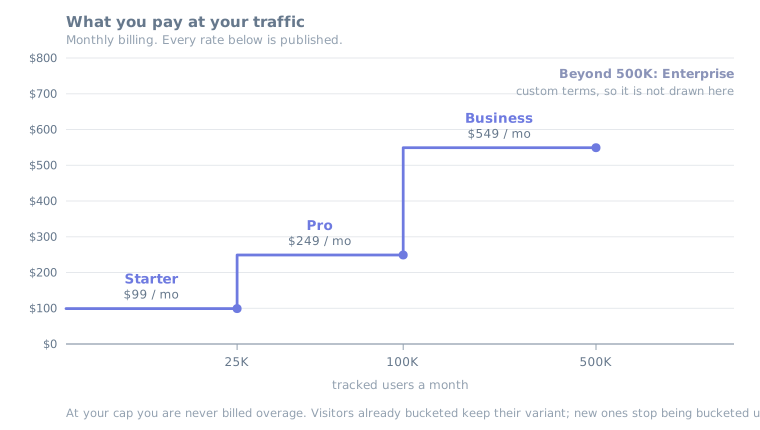
If you got this far and neither fits, the usual reason is that both are quote only and both are sold to organisations rather than to developers. That is the gap we built ABTestly for. It is code first, our prices are published in full, and you can start without booking a call. It will not replace VWO's personalization suite or Optimizely's enterprise contract, and it is not trying to. What it does is run browser side A/B tests with three statistics engines and an exact event ledger, priced from $99 a month.
If that sounds relevant, the honest way to evaluate it is not a feature table. Take one experiment you are already running, rebuild it, and see whether the direction agrees before you move anything else. We will do that rebuild with you for nothing, without asking for a login to either tool, on the Switch one experiment page. See what it costs.
Quick answers
Is VWO or Optimizely cheaper?
Neither publishes a list price, so the only comparable figures come from third parties. Vendr, updated February 2026, reports a median VWO contract of 16,330 US dollars a year across 102 purchases, and a median Optimizely contract of 81,447 dollars a year across 126 purchases. On that single source VWO is roughly five times cheaper. Both figures are annual contract values across whatever mix of products those buyers purchased, not a like for like price at a fixed traffic level, so treat the gap as a strong signal rather than a quote.
What statistics does each one use?
VWO's engine is called SmartStats and is Bayesian by default, with a frequentist model selectable, plus a choice of Sequential, Fixed Horizon or Dynamic. It applies a Bonferroni correction across variations. Optimizely's Stats Engine supports continuous monitoring and controls the false discovery rate across both metrics and variations, and Optimizely describes it as distinct from both frequentist and Bayesian approaches while carrying a frequentist style interpretation. These are different guarantees rather than better and worse: Bonferroni is more conservative, false discovery rate control is more powerful when you track many metrics.
Do VWO and Optimizely both detect sample ratio mismatch?
Yes, both do. VWO ships Sample Ratio Mismatch Detection as one of six Experiment Vitals that run continuously in the background, but its pricing matrix lists the feature on the Pro and Enterprise tiers only, not on Growth. Optimizely's version is called sequential sample ratio mismatch, or SSRM, is automatic, and covers Web Experimentation, Performance Edge and Feature Experimentation. Optimizely publishes no tier gating for it.
Which one handles flicker better?
They solve it in opposite ways and both publish their reasoning. VWO's SmartCode loads asynchronously by default, hides the page body while changes apply, and documents a fallback that shows the original content if the library does not load in time. Optimizely loads its snippet synchronously on purpose, stating that asynchronous loading increases the risk of flashing, and documents no named page hiding feature. Its guidance is to move visual changes into CSS, and to implement masking yourself where you need it.
Does either offer a free plan?
Optimizely does, though its marketing site does not mention it. Optimizely Rollouts is described in the developer documentation as free to all users and all companies, with feature flags and the ability to run one experiment at a time. VWO has no perpetual free plan but does offer a 30 day trial with no feature restrictions, full support and unlimited team members.
What are the contract terms?
Both set the term in the order form rather than publishing it. The difference is in renewal. Optimizely's terms say a subscription renews automatically for successive twelve month periods and requires 90 days written notice to stop, with 120 days notice before any fee increase at renewal. VWO's terms say the agreement renews automatically only if the order form says so, and 30 days notice is enough to decline renewal. VWO's terms also state a customer cannot cancel during an active term.
Sources checked
Checked on 6 September 2026. Prices, plans and product behaviour change. Verify before you rely on a number, and where we could not verify something we have marked it on the page rather than estimated it.
- Pricing pages: vwo.com/pricing and optimizely.com/pricing, both retrieved 6 September 2026
- VWO statistics: What is SmartStats and SmartStats configuration, retrieved 6 September 2026
- VWO health checks and guardrails: Experiment Vitals and Observatory Mode, retrieved 6 September 2026
- VWO delivery and flicker: Customizing the SmartCode, retrieved 6 September 2026
- VWO API gating: How to access the API, article updated 6 August 2026, retrieved 6 September 2026
- Optimizely statistics: Statistical analysis methods overview and False discovery rate control, retrieved 6 September 2026
- Optimizely sample ratio mismatch: Automatic SSRM detection, retrieved 6 September 2026
- Optimizely delivery and flicker: Snippet loading and Fix flashing or flickering, retrieved 6 September 2026
- Optimizely free tier: Feature Experimentation FAQ, retrieved 6 September 2026
- Contract terms: VWO terms, version 4.0 and Optimizely terms, version 2025-11, retrieved 6 September 2026
- Support commitments: Optimizely Support Policy version 2026-01, retrieved 6 September 2026
- Cost benchmarks: vendr.com/marketplace/vwo, vendr.com/marketplace/optimizely and spendflo.com, retrieved 6 September 2026
- Merger: AB Tasty newsroom and TechCrunch, both 20 January 2026, retrieved 6 September 2026
- Wingify brand consolidation, the 13 June 2026 cutover and what it left unchanged: vwo.com, aligning our domain, retrieved 6 September 2026
- Deeper on each: VWO pricing, Optimizely pricing, AB Tasty pricing, migrating from VWO, migrating from Optimizely
VWO is a trademark of Wingify Software Pvt Ltd. Optimizely is a trademark of Optimizely, Inc. AB Tasty is a trademark of its respective owner. ABTestly is not affiliated with or endorsed by any of them. The third party cost benchmarks on this page come from publicly available aggregator data, not from either vendor. Checked 6 September 2026.
The ABTestly team